Competing models of hominin body size evolution
Jacob Gardner, Thomas A. Püschel, Suzy White, Manabu Sakamoto, Chris Venditti
Abstract
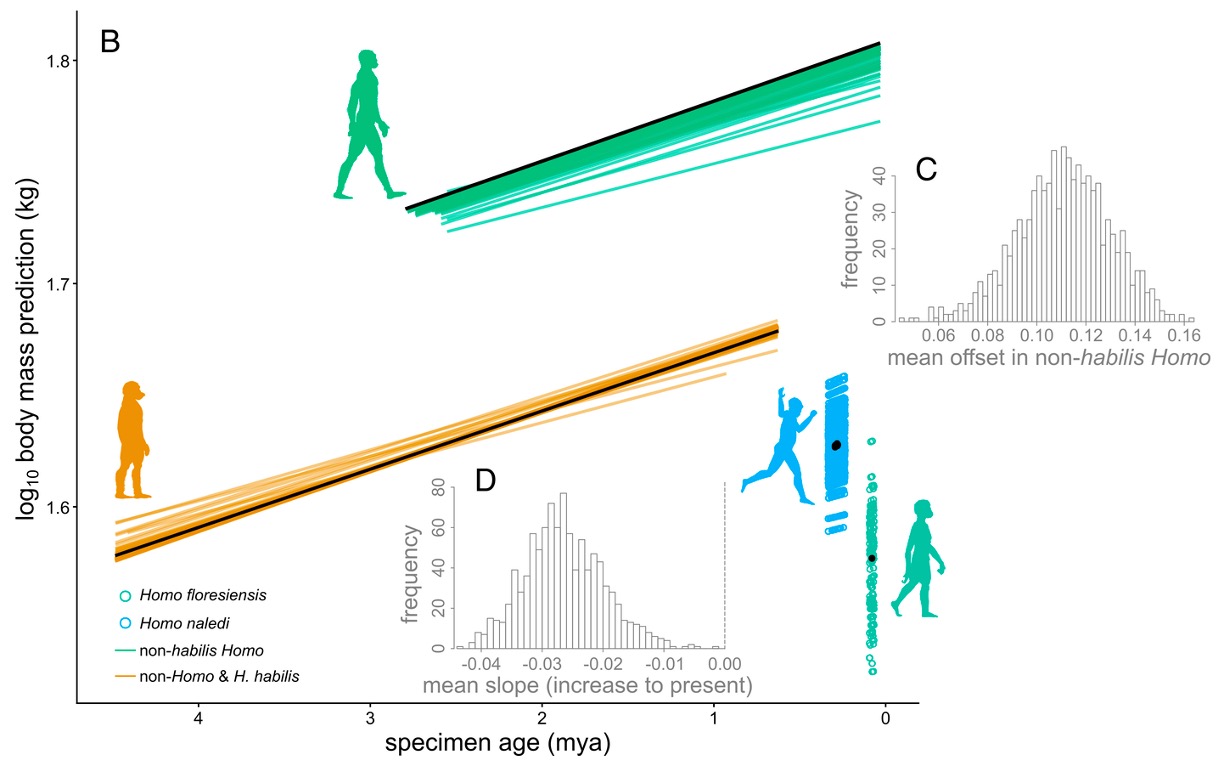
The evolutionary pattern of hominin body size remains debated, with previous studies supporting either gradual increases through time or shifts associated with particular lineages. Using Bayesian phylogenetic generalized linear mixed models and data from 386 specimens representing 21 taxa, this study evaluates these competing explanations while accounting for phylogenetic relationships, intraspecific variation, and multiple sources of uncertainty. The results provide strong support for a substantial increase in body mass among non-habilis and later-occurring Homo, together with moderate evidence for a broader temporal increase across hominins. The findings indicate that hominin body size evolution followed a more complex trajectory than either a simple progressive increase or a single shift across the genus Homo.
Media coverage
- Discover Magazine Human Ancestors Suddenly Got Bigger Around 2 Million Years Ago — With Average Body Size Jumping From 88 to 132 Pounds 22 Jun 2026
- IFLScience Ancient Human Ancestors Got Substantially Bigger 2 Million Years Ago – When They Started Walking Upright And Eating Meat 23 Jun 2026
- SciTechDaily New Study Rewrites the Story of How Humans Got Bigger 11 Jul 2026
- Earth.com Why humans grew to nearly twice the size of our ancestors 20 Jul 2026
- Sci.News New Study Challenges Long-Held Idea that Our Ancestors Simply Got Bigger Over Time 22 Jun 2026
- University of Reading Bigger bodies were a late addition for humans 22 Jun 2026