The radiation and geographic expansion of primates through diverse climates
Jorge Avaria-Llautureo, Thomas A. Püschel, Andrew Meade, Joanna Baker, Samuel Nicholson, Chris Venditti
Abstract
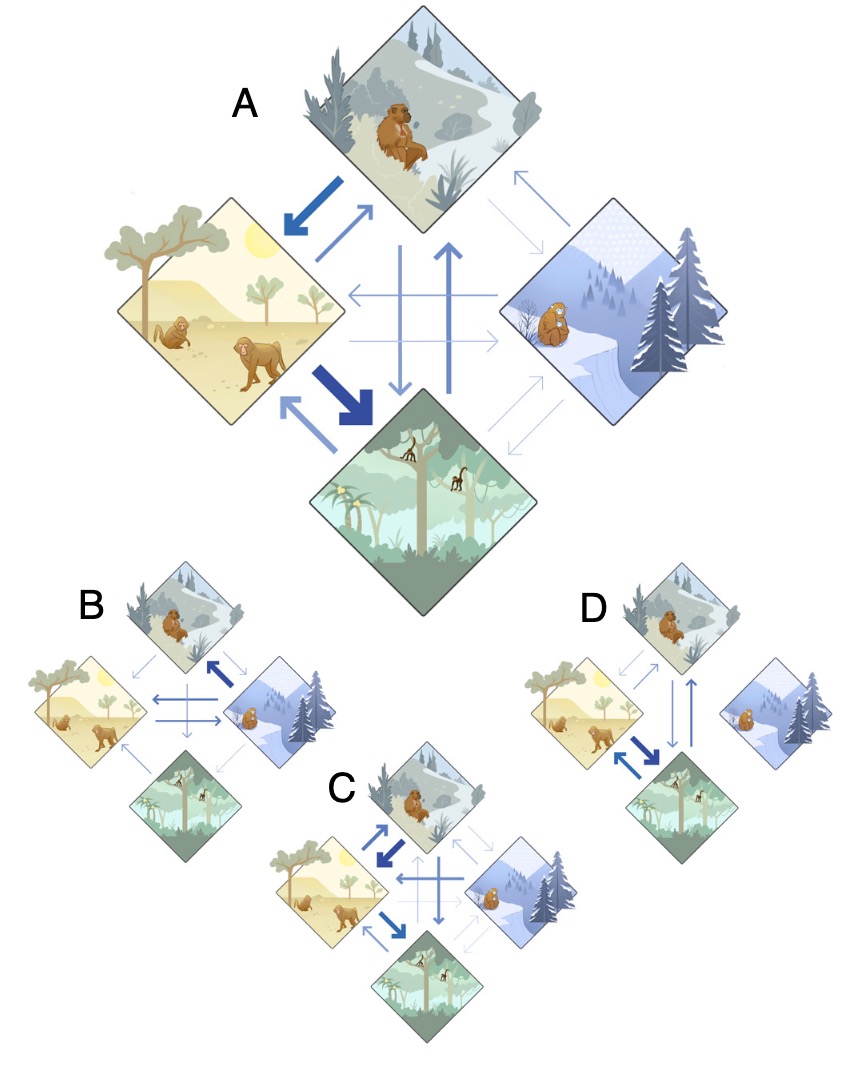
One of the most influential hypotheses about primate evolution postulates that their origin, radiation, and major dispersals were associated with exceptionally warm conditions in tropical forests at northern latitudes (henceforth the warm tropical forest hypothesis). However, this notion has proven difficult to test given the overall uncertainty about both geographic locations and paleoclimates of ancestral species. By the resolution of both challenges, we reveal that early primates dispersed and radiated in higher latitudes, through diverse climates, including cold, arid, and temperate conditions. Contrary to expectations of the warm tropical forest hypothesis, warmer global temperatures had no effect on dispersal distances or the speciation rate. Rather, the amount of change in local temperature and precipitation substantially predicted geographic and species diversity. Our results suggest that nontropical, changeable environments exerted strong selective pressures on primates with higher dispersal ability – promoting the primate radiation and their subsequent colonization of tropical climates millions of years after their origin.
Media coverage
- The Conversation Our primate ancestors evolved in the cold – not the tropics 21 Aug 2025
- New Atlas Chilling 66-million-year-old discovery rewrites primate origin story 7 Aug 2025
- Science News Explores Analyze This: Primates may have evolved in the cold 6 Mar 2026
- Earth.com Early primates evolved in cold climates, not tropical jungles 22 Aug 2025
- University of Reading Early primates survived in cold, not tropical climates 6 Aug 2025