The distal humerus of Pliobates cataloniae (Primates: Pliopithecoidea): functional and locomotor inferences
Julia Arias-Martorell, Ambra Figueroa-Torrejón, Thomas A. Püschel, Georgina Raventós-Izard, Alessandro Urciuoli, Jesús Gamarra, Sergio Almécija, David M. Alba
Abstract
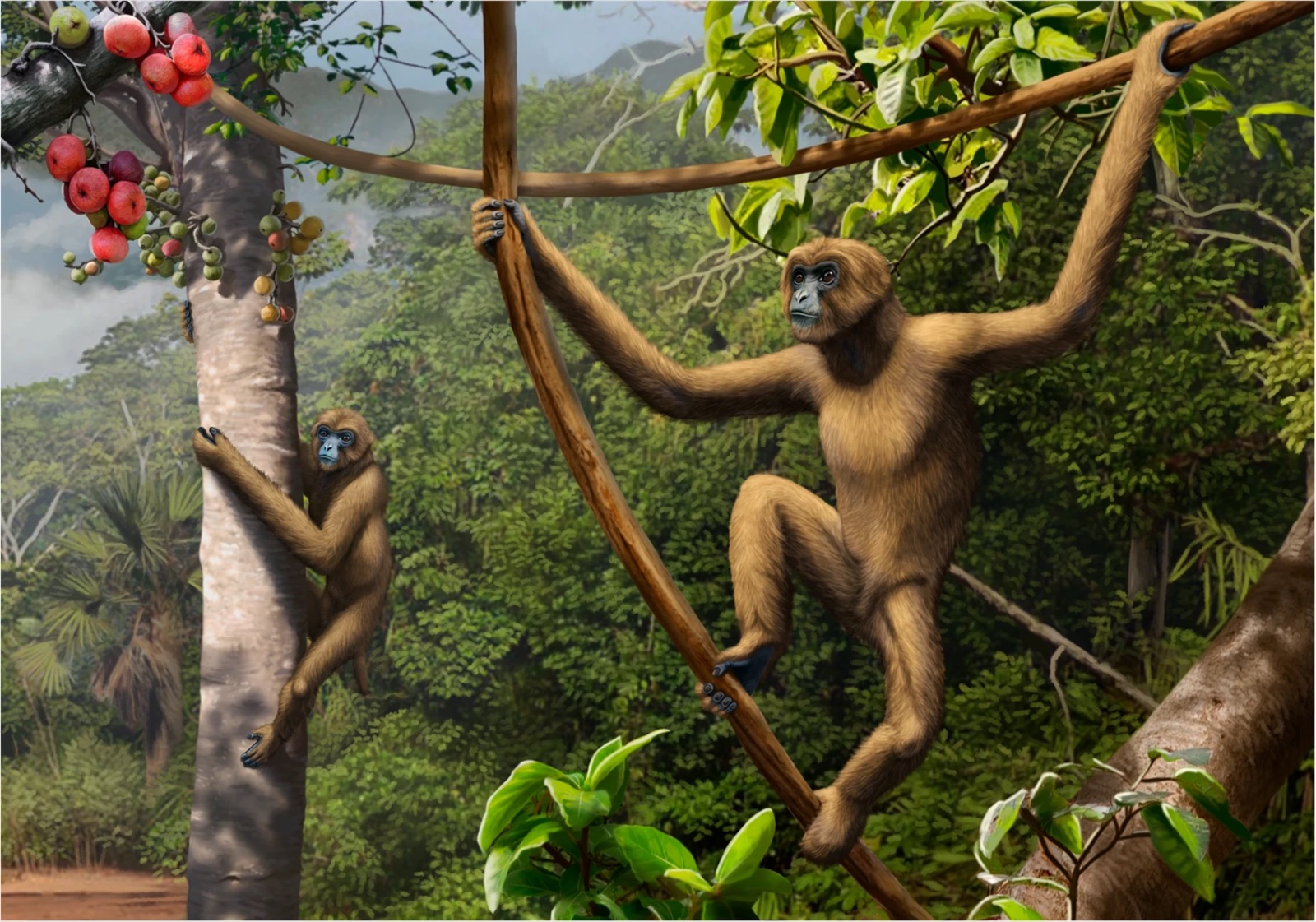
The small-bodied stem catarrhine Pliobates cataloniae(Pliopithecoidea: Crouzeliidae), from the Miocene (11.6 Ma) of the Vallès-Penedès Basin (NE Iberian Peninsula), combines catarrhine symplesiomorphies and several crown hominoid-like features that are interpreted as convergent. The most obvious modern ape-like traits of Pliobatesare found in the forelimb, particularly in the wrist and elbow joints. In the humerus, these include the lack of an entepicondylar foramen, a well-developed zona conoidea, and a globular capitulum. To quantitatively assess the degree of convergence between Pliobatesand extant hominoids, we compare their distal humeral shape with a comparative sample including extant and extinct anthropoid primates. Shape is analyzed using landmark-based, 3D geometric morphometric techniques, while the locomotor repertoire of Pliobatesand other extinct species is inferred using two-block partial least squares regression between shape and locomotor percentages. Our results indicate that the locomotor repertoire of Pliobateswould have been dominated by orthograde behaviors such as climbing/clambering and suspension, in agreement with its ape-like humeroradial joint (which is functionally related to enhanced prono-supination). Nevertheless, the humeroulnar joint of Pliobateslacks the stabilization mechanisms that are characteristic of extant hominoids and necessary for frequently engaging in suspensory behaviors. We conclude that, while suspension was probably part of the locomotor repertoire of Pliobates, this taxon did not perform the acrobatic suspensory behaviors characteristic of the similarly-sized, extant hylobatids. Consequently, we interpret the ape-like humeroradial joint of Pliobatesas an adaptation for climbing rather than modern ape-like suspensory behaviors.