The first Miocene fossils from coastal woodlands in the southern East African Rift
Rene Bobe, Vera Aldeias, Zeresenay Alemseged, Will Archer, Georges Aumaitre, Marion K Bamford, Dora Biro, Didier L Bourles, David R Braun, Cristian Capelli, Joao d’Oliveira Coelho, Jorg M Habermann, Jason J Head, Kornelius Kupczik, Anne-Elisabeth Lebatard, Tina Luedecke, Amelia Macoa, Felipe I Martinez, Jacinto Mathe, Luis Meira Paulo, Clara Mendes, Maria Pinto, Thomas A. Püschel, Frederico Tata Regala, Mark Sier, Maria Joana Ferreira da Silva, Marc Stalmans, Susana Carvalho
PDF Online version Online version
Abstract
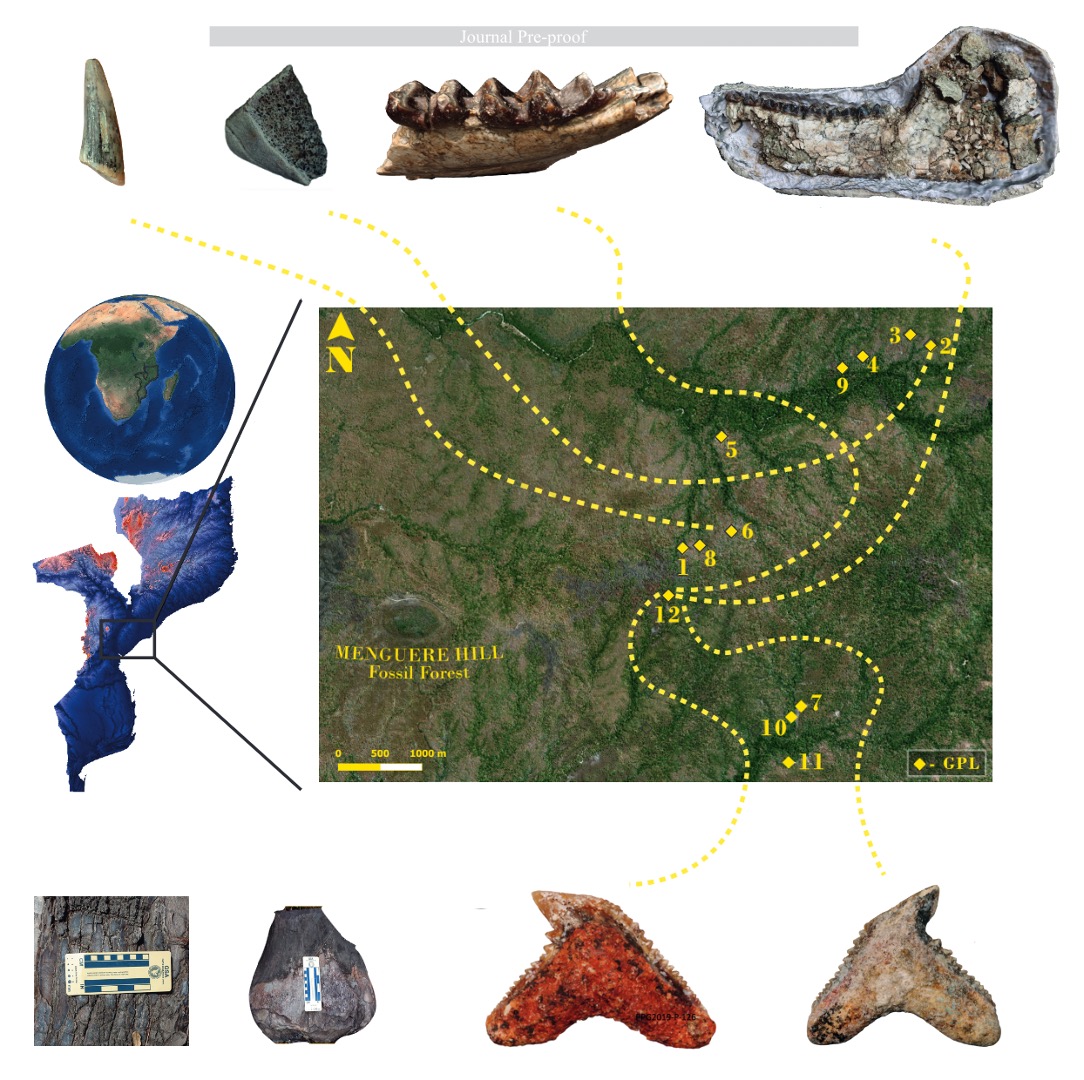
The Miocene was a key time in the evolution of African ecosystems witnessing the origin of the African apes and the isolation of eastern coastal forests through an expanding arid corridor. Until recently, however, Miocene sites from the southeastern regions of the continent were unknown. Here we report the first Miocene fossil teeth from the shoulders of the Urema Rift in Gorongosa National Park, Mozambique. We provide the first 1) radiometric ages of the Mazamba Formation, 2) reconstructions of paleovegetation in the region based on pedogenic carbonates and fossil wood, and 3) descriptions of fossil teeth. Gorongosa is unique in the East African Rift in combining marine invertebrates, marine vertebrates, reptiles, terrestrial mammals, and fossil woods in coastal paleoenvironments. The Gorongosa fossil sites offer the first evidence of woodlands and forests on the coastal margins of southeastern Africa during the Miocene, and an exceptional assemblage of fossils including new species.