Multisite analysis of infant corpse carrying in Pan reveals maternal attachment and death context as explanations of carrying duration
Reece Hammond, Thomas A. Püschel
Abstract
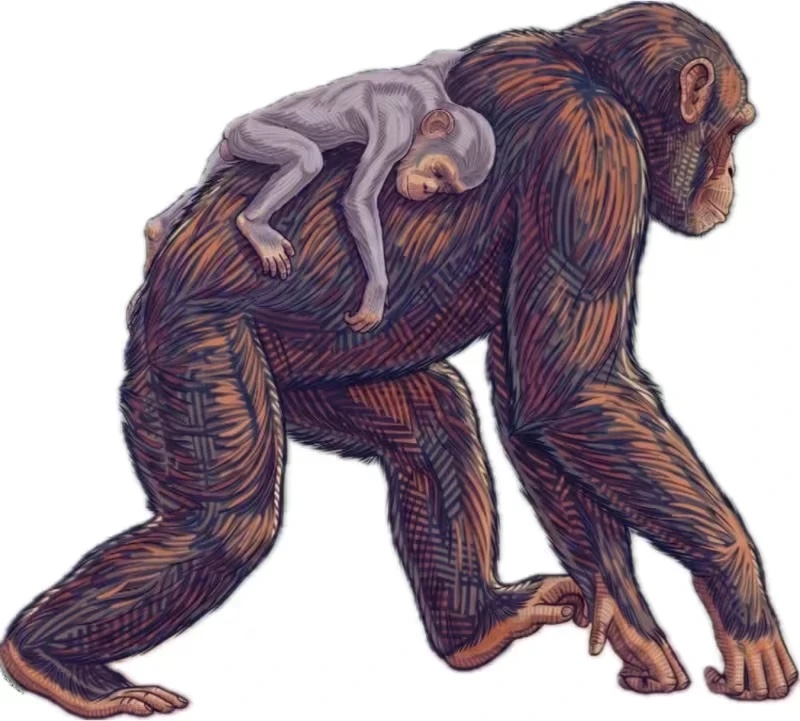
Understanding the mechanisms underlying non-human primate death-related behaviours is essential for reconstructing the evolution of human responses to death and death-related cognition. Infant corpse carrying is widely observed in chimpanzees and bonobos, yet its underlying mechanisms remain debated. Analysing 83 published cases across multiple sites using Bayesian mixed-effects models, we found strong support that infant corpse carrying duration varies with cause of death, infant age at death and site-level interbirth intervals. A less robust association of temperature with carrying duration was also identified. These results suggest that variation in infant corpse carrying duration is parsimoniously accounted for by the persistence of maternal behavioural systems being modulated by social carrying risk, dyadic bond strength, life-history context and decomposition rates. Crucially, none of the patterns observed in infant corpse carrying duration necessitate mothers recognizing death as an irreversible biological state, though they do not necessarily preclude such recognition. Given the close evolutionary relationship of Pan and Homo, this may indicate that the complex cognitive frameworks required to recognize death’s finality emerged in the hominin lineage after divergence from the Pan–Homo last common ancestor.
Media coverage
- Discover Wildlife (BBC Wildlife) Chimps can carry their deceased infants for months. Scientists are now closer to finding out why 7 Oct 2026
- Earth.com Chimpanzee mothers offer new clues about how humans respond to death 18 Sep 2026
- IFLScience Bereaved Chimp Mothers Continue To Carry Their Dead Infants – But Do They Really Understand Death? 2 Feb 2026
- University of Oxford Why do some chimpanzee mothers carry their dead infants for months? 16 Sep 2026